First ever Organic Agriculture Congress in Davao

By: Enrique Cañizares III (ESSA Researcher)
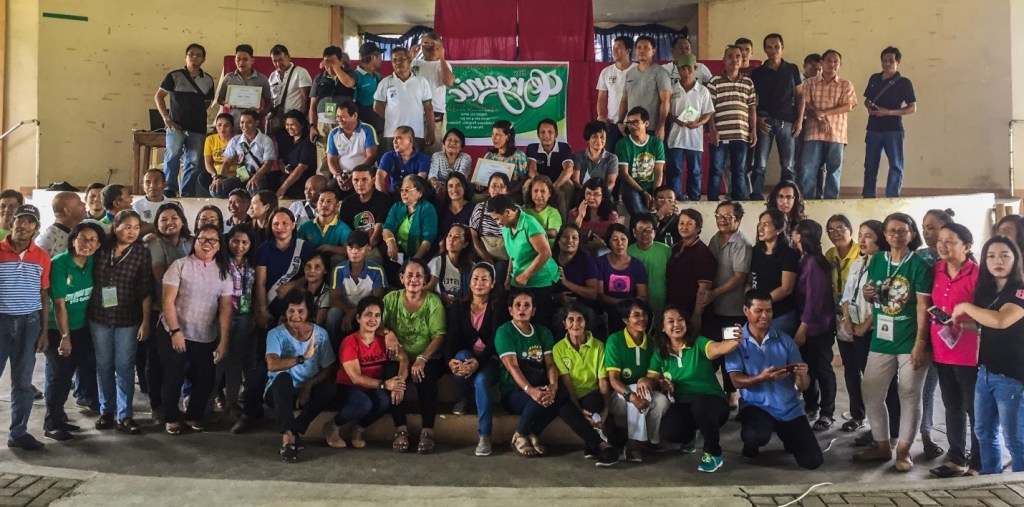
The participants of the first ever Davao City’s Organic Agriculture Congress on August 22, 2019

Last August  22, 2019, the City of Davao held its first ever Organic Agriculture Congress. The city wide congress was organized by the City Agriculture Office in cooperation with the Department of Agriculture, Municipal Agriculture Office in Davao City and was attended by the district representatives comprise of farmers, NGO’s,  and 1 Brgy. Captain

Included in the program was the Awarding of 3 outstanding farmers of Davao, and one of the awardee was Mr. Janel Juaton, a 26 year old young farmer which is very inspiring because he is one of the few young farmers who were present during the program.  Janel Juaton was trained under the guidance of MASIPAG, a non-government organization working with the youth who are interested in farming and help them rediscover and give value to what it means to be a farmer scientist at this day and age.

The NOAB’s strategic plan until 2020 for organic agriculture was presented,  but worth mentioning are the following discussions of Mr. Percy Ponciano, a Department of Agriculture representative:

  1. That the price of rice in Davao has dropped due to the application of tariff on products and the effects of Train law. Many of the farmers now are suffering due to drop in prices of their goods due to the bulk of import coming from outside the country.
  2. That Davao city is mainly producing banana and that the current rice production in the city is not enough to support its demand.
  3. That the Organic Trading Post funded by D.A Davao was demolished  by the City Government to give way to road widening.
  4. The National Organic Congress will be held this November 2020 in Tagaytay.
  5. There will be a meeting by the Department of Agriculture to assess the status of existing OTP’s all over the country
  6. The Department of Agriculture in Davao has programs for farmers who are interested to acquire Ramp Pumps and Mokosaku Equipments.
  7. The budget for the Department of Agriculture was cut to 50% during the current administration.
  8. The reason why chemical fertilizers prices go up is because it is affected by Global prices in gasoline as it is a byproduct of gasoline production.

Also tackled in this event were the issues on coconut industries because gracing this event also was the representative  of the Philippine Coconut Authority who gave a short presentation of its programs.

One of the most interesting question raised by the participants was, is there an increase of farmers going into organic farming. The representative from D.A. said that over-all their work in D.A is very difficult. Not only that the department’s budget was cut in half, the problem of resilience and consistency from the farmers who are converting their farms from conventional farming to organic farming is also one of the main reasons these farmers in the end revert back to chemical farming. In other words “Wala ka lahutay” in bisaya, meaning “They can’t finish the whole process”, or in FarmSci NASSA’s term, the inner condition of the farmer was not there. And all throughout the program this statement keeps popping not only from the government representatives but as well as from NGO’s and from the farmer themselves.

The participants were served with organic food and at the same time no plastic packaging except for the dessert which was durian flavored. None the less the City Agriculture office was making efforts to lessen the carbon footprint of the event.

Six (6) motions that were considered by the organic agriculture congress to be included in the passing of resolution in the Sangguniang Bayan that arose coming from the organic farmers and advocates:

  1. Only organic products will be provided in all organic agriculture events.
  2.  To ban all chemical fertilizers not only in Davao but nationwide as well.
  3. To include the Participatory Guarantee System in R.A 10068.
  4. For the City Agriculture Office of Davao to explain why the 1.5M Php fund from  the Department of Agriculture was not utilized to create a techno-demo farm for Davao City.
  5. The supervision to include Organic Agriculture in the Department of Education.
  6. The allocation of 5% of the Barangay funds for Organic Agriculture programs.

Though many of the organic farmers of the Davao City weren’t able to attend and that no media was involved for the first ever City Congress for Organic Agriculture, none the less it is a big step towards the advocacy of organic agriculture all throughout the country.

ESSA Build Up Activity

MUNICIPALITY OF LAMBUNAO LEADERSHIP TRAINING WITH THE THEME “TATAK FIRST CLASS FOR SERVICE”

In preparation for the Organic 4.0 National Conference, ESSA is working, coordinating and participating with different activities in different areas to invite and inform the public what will happen on December 17 to 21, 2019 at Angat, Bulacan and to continue to educate and inspire others and involving the youth in Advancing Sustainable Agriculture.

This activity was graced and inspired by the University of San Agustin professor, Hermogenes Gacho Jr., among his achievements, Mr. Gacho is an environmental advocate, climate reality leader trained by former U.S. Vice President Al Gore; Gemma B. Sumague, Program Coordinator of ESSA; Ariel Lastica,  ESSA Council Member; Gideon Palmejar, SEA, Inc. (SIAD) Municipal Coordinator; and Keziah Lei S. Sarmiento, Field Researcher, ESSA.

Involved and invited to attend at the Grandstand of West Visyayas State University, Lambunao, Iloilo last Asugust 16, 2019 were the students of Panluran National High School, Binabaan National High School, Harvester Christian Academy, Lambunao National Highschool, and Coordinating Councils of Lambunao National High School.

Ariel Lastica, Executive Director of Lambunao Champion Farmers and Council Member of ESSA

Ariel Lastica, Executive Director of Lambunao Champion Farmers and Council Member of SEA-ESSA talked about transformative leadership and shared his journey before he became a leader by sharing his educational background, his experiences, and the turning points of his life. He showed pictures of the world youth leaders to set an inspiration to all the participants. He ended his talk by leaving four (4) points on how to transform into a world leader which are speaking, listening, doing, and framing.

Gemma B. Sumague, the Program Coordinator of ESSA

Gemma B. Sumague, the Program Coordinator of ESSA, introduced to the participants what is the organization all about. She also stated the different activities and projects of SEA Inc. specifically the ESSA. Ms. Sumague briefly discussed the event that will be happening on December and invited the students to become a volunteer.

Hermogenes Gacho Jr. the guest speaker, talked about climate leadership

Hermogenes Gacho Jr. talked about climate leadership. He shared important informations that are really happening today and how to deal with even with little actions from the participants. He also showed some pictures to tackle the cause and effect of climate change to the Earth. He encouraged the students to have an initiative in terms of taking care the environment and become a role model to other people.

Invited guest and participants

Council Meeting

ESSA DEEPENING OF INNER CONDITION AND FINALIZING THE PROGRAM FOR ORGANIC 4.0 NATIONAL FAIR.

This image has an empty alt attribute; its file name is 20190730_140124-1-1024x592.jpg
Member of the councils with the ESSA Team

As set during the Strategic Planning Workshop one of the internal activities set for ESSA is to conduct a regular ESSA council meeting every other month until March 2020.  Last July 30-31, 2019, the ESSA council gathered again for this scheduled meeting.  To take advantage of this event (gathering of the council), they grabbed this opportunity to collectively work for future the success of the upcoming event on February 11-15, 2020 national fair. 

The participants during this meeting were able to experience the deeper meaning of the Inner Conditioning, were inspired and discovered on what else they could do towards Organic 4.0. 

From the prepared agenda, the program for December national fair was realized.  The resource person and the topics were finalized and there were only few more things to be polished for the upcoming meetings until the National Fair. 

On this event also, the secretariat team was introduced to the ESSA council.  The guidance of the council to achieve the deliverables of the secretariat was solicited for the success of the phase 2 of ESSA.

The Assistant executive Director of Solution Ecosystems Activator, as head of ESSA secretariat was also able to present the ESSA roadmap to the council. This is in addition to the updates and to re visit what had been accomplished and what is ESSA now after one year.

INNER CONDITIONING WORKSHOP: An entry for the network’s membership

Respondents for the Invitation of Inner Conditioning Workshop

The two (2) days Inner Conditioning Workshop was held last December 22 to 23, 2018 at the Center for Bayanihan Economics, Angat, Bulacan and was attended by ten (10) participants.  To name were Digna Ruth Daliva, In Charge of CBE extension; Berna Halonghong,  Social Entrepreneurship Program (SEP) Coordinator in CBE; Esperanza Oebanda, CBE staff; Ricardo Sanchez, Agri-preneur in Angat, Bulacan; Venancio Garde, National Traning Coordinator for Systems of Rice Intensification (SRI) Philippines; Christopher Enate, President of Dao SRI Farmers Association; Ariel Lastica, Executive Assistant of the Mayor in Lambunao, Iloilo; Enrico Mora, President of CANAMA Farmers Association in Sta. Barbara, Iloilo; and  Nida Salazar, TLE Coordinator in Culasi National High School.

Nicanor Perlas, facilitator of the Inner Conditioning Workshop

The training aims to establish the initiatives on the basis of inner conditioning or deepening of discipline and ethics of the members.

From these participants, the ESSA council shall be selected.  As a result of the Strategic Planning Workshop, that the member of the ESSA should undergo an Inner Conditioning Workshop.  Considering the network objective: “To harness the synergistic effects of converging diverse stakeholders at multi-dimensional realities (earthly and spiritually) and disciplinary levels including the latest findings of the second and more spiritual scientific revolution – all towards advancing sustainable agriculture for societal good”, to strengthen the Inner condition of the members is necessary.  So it was agreed that to be an official member of the network, one must undergo this workshop.

The official members of ESSA with
Nicanor Perlas

As a result of this workshop, the new council officers were the following: Digna Ruth Daliva as Chairperson; Enrico Mora, Vice Chair; Christopher Enate, Venencio Garde, and Ariel Lastica as members of the new ESSA council officers.

The network agrees with the Asian SA definition consensus (circa 1991) that there are 7 dimensions to sustainable agriculture as follows: 1. ecologically sound and appropriate technologies; 2. economically viable (based on bayanihan or solidarity economics); 3. embodies good governance; 4. culturally sensitive (to IP and peasant farmer practices) and advances post-materialist sciences and relevant conventional science; 5. societally just and equitable achieved through societal threefolding or the principled collaboration between civil society, government and socially responsible businesses; 6. develops the full humanity potential; and 7 acknowledges the importance of the spiritual processes in nature, humans and society. The  inner conditioning workshop of ESSA is an initiative that advances the 6th dimension of sustainable agriculture. 

The birth of ESSA

Participants were grouped during the workshop for the haring ideas on what would be the objectives of ESSA.

In order to establish a wide network and collaboration among organic agriculture scientists and practitioners, ESSA initiated a National Consultation Meeting. In this activity the practitioners from different sectors comprising the academe, local government units, private practitioners and local farmers who are practicing organic agriculture will gather primarily, to influence and encourage the agricultural scientists to tap their existing networks, technical expertise, funders, institutions and human resources to implement the results of this national workshop. Another one is to publish the researches of organic scientists that will serve the outreach of the organic agriculture in NICE.

Also, encourage the leagues of mayors in municipalities and cities to support and promote this initiative.  

Nicanor Perlas giving the rationale of the ESSA National Consultation

According to Daily Guardian News a local newspaper issued on August 30, 2018 page 13, “The LOAM-C president Rommel Arnado stressed that he believes in organic farming saying that “I am very passionate sa aking ginagawa (I am very passionate in what I do) against all odds and the wishes of my friends especially my family.”

Life is not all about work and making money. But I think we know by reading the Bible, we will realize that life is all about sharing. Kung anong ma natin, kung anong maitutulong natin sa kapwa natin, gawin natin. (Whatever we can share, whatever we can extend help to others, let’s do it),” Arnado said.

Mayor Rommel C. Aranado introducing the League of Organic Municipalities and Cities Philippines to the participants of the National Consultation.

He added that establishing a league of good mayors to help promote organic farming in their municipalities and cities will minimize poverty because people engage in organic farming. 

“Meron tayong health and wellness obligation sa ating komunidad. Hindi naman mahirap ang organic, nagiging mahirap ito because we make it hard (We have health and wellness obligation in our community. Organic is not difficult, it becomes difficult because we make it hard),” he added.”  

Despite the typhoon, the Consultation Meeting was pursued and attended by Forty-Nine (49) participants coming from LGU partners, agricultural scientists, farmers’ association representatives, Lifebank Foundation representatives and SEA, Inc. staff last August 10-12, 2019 at CBE, Angat, Bulacan.  It is in this assembly that ESSA emerged through a consensus of the participants.  Originally, the project name was ESSA, but because of the consideration that the main stakeholders of the project are the farmers, the word “Farmers” or “Farm” was included making it “ESSA”.